


Ruhepol Centralkino / Acoustic Refuge Centralkino
Part of Hörstadt / Acoustic City
Copyright: Linz09
The Acoustic Refuge in Centralkino at Landstraße 36 was an ideally situated downtown retreat through November 2009.
Ruhepol Centralkino was based on an idea by Viennese urban researcher and acoustician Peter Payer, whose concept was, in turn, inspired by an early 20th-century precursor. Almost 100 years ago, Dresden physician R. Sommer set up a public hall of silence that was a very popular feature among visitors to the Hygiene Exhibition there.
The aim of this historical model of a publicly accessible acoustic refuge was above all to have a calming effect upon citydwellers who had been made “nervous,” edgy and irritable by their increasingly noisy surroundings and the acceleration of everyday life. Thus, a major part of Acoustic City’s mission was to establish a space amidst the cityscape that was free of noise pollution and that enabled people to experience the elementary auditory phenomenon of silence in a non-religious setting. The 28,000 visitors to this facility attested to the need for and interest in an acoustic refuge.
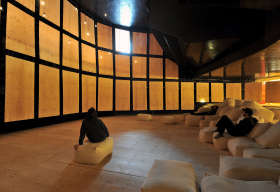
The venue has had an eventful past. Landstraße 36 was once the address of Hotel Schiff, the scene of bloody skirmishes between the forces of the Austro-fascist regime and republican resistance fighters during the Austrian Civil War in February 1934. Later, the building complex housed the Social Democratic Party’s local headquarters and Centralkino, a mecca for generations of Linz cinéastes and a bastion that defied the extinction of downtown movie theaters into the 21st century. The actual acoustic refuge was located in the former screening room. The exits to the lobby along the side walls were closed off; the loge section of the original layout was reactivated and used as an access level. Both of the round spaces in the rear corners of the building were coated with warm-colored, brightly-lit soundproofing (convoluted) foam. They thus served as both attractive transitional zones and buffers between the lobby and the acoustic refuge. The ‘80s lobby furnishings left over from the movie-house days were removed. The underlying structures—some original fittings going back to 1909—were brought to light and given a coat of reed-green paint. A lighter-colored drapery cocoon partitioned off a space within a space amidst this raw substance refined with color. Here, at small tables, guests could drink tea, converse or read. Inside the main hall, wood was the sensorially soothing main design element. A loosely-woven tissue of plywood sheets was draped over the structural walls. A window shaft situated high up the wall let a concentrated ray of daylight stream in. With a height difference of about one meter to the loge level, the floor became a landscape of wood featuring steps and inward-sloping multi-level terraces on which groupings of beanbag chairs offered the possibility of sitting, reclining and listening to the sound of the space.
In November 2009, the CENTRALKINO ACOUSTIC REFUGE served as a place for mourning in conjunction with FESTIVAL 4020 GOD. In the public-yet-secluded and secular ambience of this space, mourners could avail themselves of the services of experienced grief counselors.
WHAT // Acoustic Refuge
WHERE // Ruhepol Centralkino: Landstrasse 36, 4020 Linz
WHEN // November 29, 2008-November 21, 2009
Copyright: Linz09
Ruhepol Centralkino was based on an idea by Viennese urban researcher and acoustician Peter Payer, whose concept was, in turn, inspired by an early 20th-century precursor. Almost 100 years ago, Dresden physician R. Sommer set up a public hall of silence that was a very popular feature among visitors to the Hygiene Exhibition there.
The aim of this historical model of a publicly accessible acoustic refuge was above all to have a calming effect upon citydwellers who had been made “nervous,” edgy and irritable by their increasingly noisy surroundings and the acceleration of everyday life. Thus, a major part of Acoustic City’s mission was to establish a space amidst the cityscape that was free of noise pollution and that enabled people to experience the elementary auditory phenomenon of silence in a non-religious setting. The 28,000 visitors to this facility attested to the need for and interest in an acoustic refuge.
The venue has had an eventful past. Landstraße 36 was once the address of Hotel Schiff, the scene of bloody skirmishes between the forces of the Austro-fascist regime and republican resistance fighters during the Austrian Civil War in February 1934. Later, the building complex housed the Social Democratic Party’s local headquarters and Centralkino, a mecca for generations of Linz cinéastes and a bastion that defied the extinction of downtown movie theaters into the 21st century. The actual acoustic refuge was located in the former screening room. The exits to the lobby along the side walls were closed off; the loge section of the original layout was reactivated and used as an access level. Both of the round spaces in the rear corners of the building were coated with warm-colored, brightly-lit soundproofing (convoluted) foam. They thus served as both attractive transitional zones and buffers between the lobby and the acoustic refuge. The ‘80s lobby furnishings left over from the movie-house days were removed. The underlying structures—some original fittings going back to 1909—were brought to light and given a coat of reed-green paint. A lighter-colored drapery cocoon partitioned off a space within a space amidst this raw substance refined with color. Here, at small tables, guests could drink tea, converse or read. Inside the main hall, wood was the sensorially soothing main design element. A loosely-woven tissue of plywood sheets was draped over the structural walls. A window shaft situated high up the wall let a concentrated ray of daylight stream in. With a height difference of about one meter to the loge level, the floor became a landscape of wood featuring steps and inward-sloping multi-level terraces on which groupings of beanbag chairs offered the possibility of sitting, reclining and listening to the sound of the space.
In November 2009, the CENTRALKINO ACOUSTIC REFUGE served as a place for mourning in conjunction with FESTIVAL 4020 GOD. In the public-yet-secluded and secular ambience of this space, mourners could avail themselves of the services of experienced grief counselors.
WHAT // Acoustic Refuge
WHERE // Ruhepol Centralkino: Landstrasse 36, 4020 Linz
WHEN // November 29, 2008-November 21, 2009
Gallery


Press Information to Ruhepol Centralkino
Download Press Photos Ruhepol Centralkino
to the main project pageback
